
Christmas DOOH: What 2024 Taught Us and What Works in 2025
Updated: May 19
By the second half of December 2025, most brands are no longer planning Christmas. They are operating inside it.
Budgets are committed. Media is live. Creative is in-market.
The remaining question isn’t what to run, but how well it’s working under pressure.
UK AA/WARC forecasts put Q4 2025 advertising spend at £12bn, with total UK ad investment up 8.2% year-on-year, despite continued pressure on household finances.
That spend is competing for attention from consumers who are:
Mentally fatigued
Short on time
Highly selective
Actively filtering anything that feels unnecessary or misjudged
The key lesson from Christmas 2024 - reinforced throughout 2025 - is that attention hasn’t collapsed. It has become conditional.
People will still notice messages, but only when those messages feel appropriate to the moment and environment they appear in.
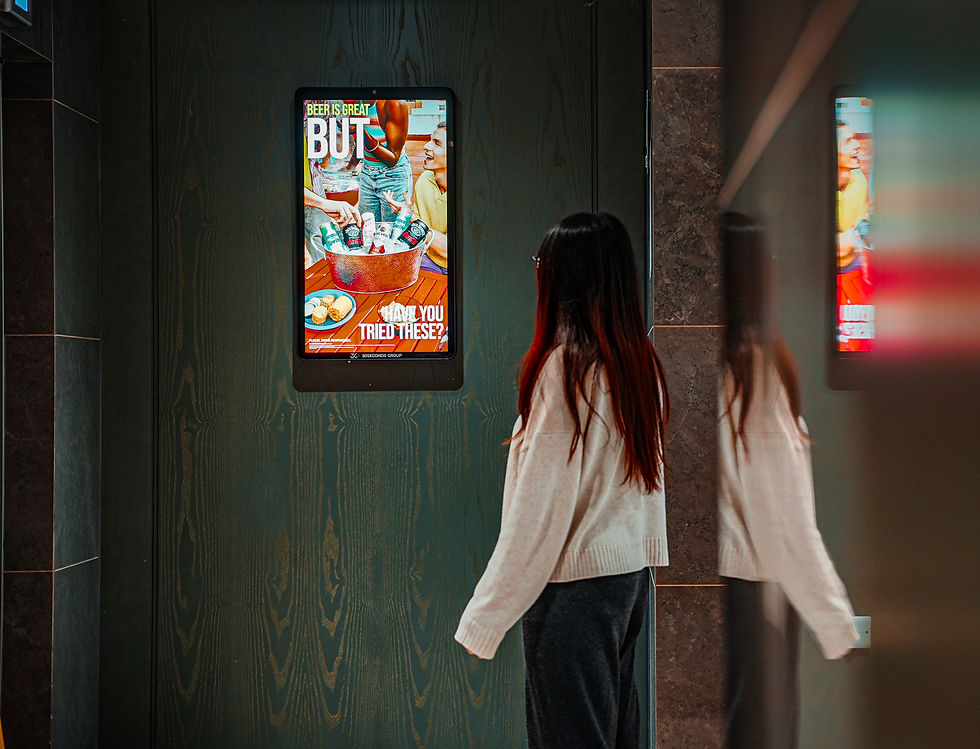
This is where near-home DOOH has quietly changed role. Now acting not as high-impact media, and not as spectacle, but as a reinforcing layer within daily routines.
Used badly, it feels like clutter.Used well, it behaves like information that belongs.
This piece breaks down what changed, why it matters, and what brands should do in the final days before Christmas.
Part 1: What fundamentally changed after Christmas 2024
1. Relevance overtook emotion as the primary filter
For over a decade, UK Christmas advertising rewarded emotional escalation.
Big films, narrative payoffs, soundtrack-led storytelling.
That model still exists - but Christmas 2024 exposed its limits.
Industry analysis (including SEC Newgate’s review of UK festive advertising) showed that audiences were no longer judging Christmas campaigns on how emotional they were, but on whether they felt situationally appropriate.
Through 2025, this sharpened into a simple mental filter:
Is this relevant right now?
Is this understandable without effort?
Does this respect where I am and what I’m doing?
If the answer is no, the message is discarded - regardless of craft quality.
This matters particularly for near-home environments, which are not entertainment contexts.Lift lobbies, entrance foyers and shared building spaces are:
Transitional
Functional
Routine-based
People are not there to be persuaded.
They are there to move between parts of their day.
2. Near-home DOOH stopped behaving like advertising - and started behaving like infrastructure
One of the biggest strategic mistakes brands make is treating residential or workplace DOOH as an indoor billboard.
It isn’t.
These screens exist alongside:
Building notices
Visitor information
Safety updates
Operational messaging
When campaigns work, they don’t compete with this content - they align with it.
That alignment matters more in 2025, as scrutiny around shared-space media increases.
Campaigns that generate the least resistance - and the strongest recall - share three characteristics:
They don’t demand attention
They don’t overstay their welcome
They give something back (clarity, reassurance, direction, relevance)
This explains why public, civic and utility-led campaigns have performed so consistently well in near-home DOOH.
They feel legitimate because they behave like useful information, not interruption.
Commercial brands can achieve the same effect - but only by adopting the same discipline.
Part 2: What actually worked in festive creative (and why)
1. Short-form clarity did more work than long-form ambition
Christmas 2024 marked the moment the industry quietly accepted something uncomfortable:
Long-form festive storytelling was no longer doing the bulk of the work.
Hero films drove coverage and social discussion.
But in environments like near-home DOOH, short-form, highly legible creative delivered most of the impact.
In residential and workplace settings, people encounter screens during:
Brief pauses
Transitional moments
Repeated daily routines
The creative that performed best followed three rules:
One idea. One role. One takeaway.
Anything more complex was either misunderstood or ignored.
This isn’t simplification for its own sake. It’s a response to December reality.
By late December 2025, people are juggling:
Delivery cut-offs
Social commitments
Budget constraints
Family logistics
They are seeking resolution.
2. Motion worked when it structured time - not when it added stimulation
By now, the industry no longer needs convincing that motion works in DOOH.
Neuroscience studies consistently show full-motion DOOH outperforms static for memory encoding and recall.
But Christmas 2024 revealed why.
Motion works because it organises information over time.
In near-home environments - where dwell times are longer and exposure is repeated - motion allows brands to:
Pace information
Reduce cognitive effort
Guide attention instead of competing for it
The most effective executions treated the screen as a three-beat sequence:
Orientation – what is this about?
Resolution – why does it matter now?
Closure – what should I remember or do?
When motion is decorative, it adds noise.
When it’s structural, it adds clarity.
3. Day-parting became baseline, not innovation
By the second half of 2025, time-of-day relevance is no longer a creative flourish. It’s expected.
Festive campaigns that performed best aligned messages to actual daily rhythms, not generic festive language:
Morning – organisation, preparation, reassurance
Midday – convenience, quick decisions, food and utility
Evening – relaxation, entertainment, small indulgences
Weekends – family activity, experiences, bigger commitments
Near-home DOOH supports this naturally because the same audience encounters the same screen at predictable times.
When messaging shifts to reflect that rhythm, it feels considered rather than targeted - a crucial distinction in shared environments.
4. Emotional tone shifted from spectacle to relief
Another clear lesson from Christmas 2024 - reinforced throughout 2025 - was emotional recalibration.
In high-pressure December contexts, audiences responded better to:
Reassurance
Ease
Lightness
Practical resolution
Heavy nostalgia and grand sentiment underperformed in near-home placements, because emotional labour was too high.
The strongest creative didn’t ask people to feel more. It helped them cope better.
Part 3: Christmas DOOH: A framework brands can actually use
Five non-negotiable principles for near-home Christmas creative
Rather than more “best practice”, these are constraints brands should design within.
1. Immediate comprehensionIf it can’t be understood in three seconds, it won’t earn the next twenty.
2. Physical context firstDesign for where the screen lives, not where you wish it lived.
3. Ruthless hierarchyOne visual job. One focal point. One takeaway.
4. Motion as structureUse time to sequence meaning, not to add stimulation.
5. Usefulness over persuasionReduce uncertainty. Clarify options. Set expectations.
Part 4: Why near-home DOOH matters most in the final days
As Christmas approaches, the role of near-home DOOH narrows - and strengthens.
People encounter these screens:
Before opening a laptop
Before deciding what to eat
Before planning the evening
Before leaving again
That proximity doesn’t automatically increase influence. It increases the value of clarity.
In the final days before Christmas, brands that perform best are those that:
Help people decide
Remove friction
Reduce second-guessing
Near-home DOOH is structurally suited to this role - but only when creative is honest about the job it’s doing.
Part 5: A practical playbook for the final 10 days of Christmas 2025
If you are still live - or still optimising - this is where focus should sit now.
Build modular, DOOH-first creativeStop cutting down TV. Design for dwell and sequencing.
Start with a real December problemNot a brand story - a human situation.
Plan for calm sequencingLet meaning unfold rather than arrive all at once.
Use time of day deliberatelyAs context, not as a targeting trick.
Test under fatigue
If it works when you’re tired, it works.
Conclusion: good creative earns its place
The clearest lesson from Christmas 2024 - and the defining signal of Christmas 2025 - is this:
The best festive creative doesn’t demand attention. It earns it.
Near-home DOOH is effective because when used properly, it fits.
The brands that understand this aren’t just buying media. They’re respecting routines.
And in December, that respect is what cuts through.


Comments