
Why Dayparting and Residential DOOH Are the Perfect F&B Combination
Updated: May 19
There is a version of advertising that interrupts, and a version that arrives at exactly the right time. For most of advertising history, F&B brands have been working with the former and aspiring to the latter. Dayparting in digital out-of-home, applied to residential screen media, is how you actually get there.
The food and drink purchase decision is one of the most habitual, contextual, and repeated decisions a consumer makes every single day. It is not a considered purchase like a car or a holiday. It lives in the margins of the day, shaped by hunger, convenience, routine, and most importantly, what they have most recently seen. That last factor is where advertising earns its return. The question has always been: how do you place your brand in front of that decision at the precise moment it is being formed?
The Outdated Mental Model
For a long time, media planning for F&B brands followed a fairly predictable logic. Television for reach and emotional connection. Digital for targeting and performance. Out-of-home for brand presence. Each channel had its designated role, and the job of planning was largely to divide budgets between them efficiently.
That model made sense when media was largely static. When a billboard stayed the same for a month, you planned around what it could deliver broadly rather than what it could deliver precisely. But DOOH has changed the operating conditions entirely, and many media plans have not fully caught up.
Scott Mitchell, Managing Director at Vistar Media, put it plainly: "2026 is the year OOH fully steps into the modern marketing ecosystem. We're seeing three forces converge at once: digital saturation, rapid DOOH growth, and major advancements in measurement." The channel is no longer a blunt instrument. It is precise, responsive, and increasingly accountable.
What Dayparting Actually Changes
Dayparting in DOOH is the ability to serve entirely different creative executions at specific times of day, automatically and at scale, across a network of screens. The concept is borrowed from broadcast media, but the application in DOOH is considerably more powerful because the screens are placed inside the environments where purchasing decisions are actually being made, especially in F&B.
The most instructive analogy is not television scheduling. It is the corner shop. The good ones stock their shelves differently in the morning than in the evening. The display at the front changes. The impulse products shift. The shop is effectively running a different offer depending on when you walk in, because the shop owner understands that the person who comes in at 7am is not the same version of the consumer as the person who comes in at 7pm, even if they are literally the same person.
Dayparting in DOOH gives F&B brands that same capability, at residential scale. A breakfast brand. A coffee platform. A meal kit. A takeaway app. A grocery retailer. Each of these has a moment in the day when their message lands with maximum relevance, and each of them currently has a mechanism available to ensure their creative runs exactly then.
Karan Singh, GM UK at Vistar Media, made the creative case well, writing in The Drum: "The most impactful DOOH food and drink campaigns blend creativity with context in a way that transforms advertising into a timely, meaningful experience, whether that's offering breakfast promotions to commuters or showcasing refreshing drinks on a warm day. By embracing programmatic, brands can deliver highly relevant messaging at scale, ensuring they activate at the perfect moments."
Why the Location Matters More Than You Might Think
Most DOOH environments, however well planned, reach people who are in transit. The mindset of a person moving through a train station or driving past a roadside panel is fundamentally different from someone who has just arrived at their building after a working day. The first is going somewhere. The second has arrived. They are transitioning from the outside world into their home environment, and in that transition, they are making decisions.
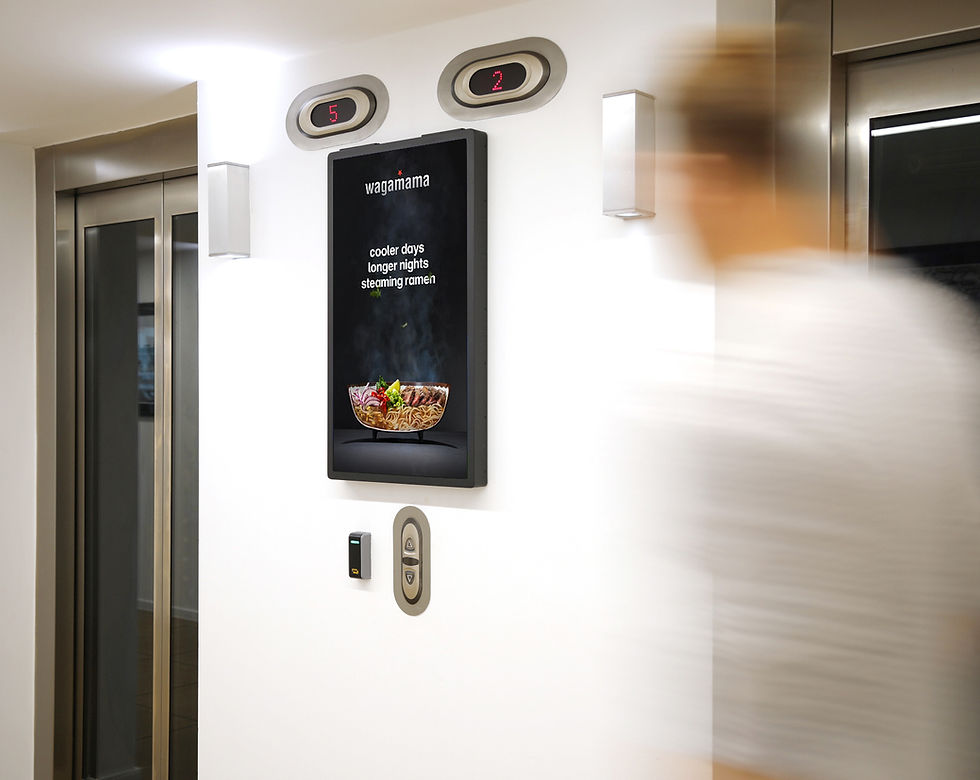
What am I cooking tonight? Should I order something? Do I have everything I need? These are not abstract future decisions. They are immediate. And they are being made in a lift lobby.
This is the structural advantage of 30Seconds Media's network. Our screens sit in the lift lobbies and entrance foyers of residential apartment buildings across 20 UK cities, reaching an audience that uses those screens every day, multiple times a day, in an environment that naturally generates high attention. Our own channel research shows that 88% of residents have seen the advertising on our screens, and 68% went on to take a positive action after seeing an advert. Dwell time averages 30 seconds per visit. For context: that is longer than most online video ads that people actively choose to skip.
The residential audience of our screens is also not a broad, undifferentiated mass. It skews 18 to 34 (47% of our residential network), with an average household income of £41,801.
This is the demographic that orders food online most frequently, engages most readily with new food and drink brands, and makes purchasing decisions daily in the exact categories F&B brands compete in.
Frequency That Works for You, Not Against You
One of the less discussed but commercially significant aspects of residential DOOH is the nature of the frequency it delivers. Most advertising frequency is passive. You see the same ad repeatedly on the same platform and the repetition either builds familiarity or, eventually, breeds irritation.
Residential DOOH frequency works differently, because the audience is moving through the same physical space at different points of their day. The morning impression reaches a different mental state than the evening one. Someone leaving for work at 7am and seeing a coffee brand creative is in a completely different mindset than when they see a meal kit promotion at 6pm on their way back up. Frequency here is an asset not because it hammers the same message, but because it creates multiple relevant contact points across the daily routine.
According to Nielsen, consumers are 76% more likely to respond to advertising that matches their current context, defined by time, place, and interests. Dayparting is the mechanism that keeps each impression contextually matched. Without it, the repetition of a residential network is good. With it, it is genuinely powerful.
A Real Example of the Logic in Action
Arla Foods in the UK demonstrated exactly this kind of dayparted thinking when they tailored DOOH content by time of day, displaying breakfast recipes featuring their lactose-free milk on morning screens in shopping centres, then switching to evening recipes in the afternoon, aligning with when those meals were on consumers' minds. The creative itself was not dramatically different. The timing made it feel entirely relevant.
Applied to a residential network, where the audience is arriving home hungry and making real-time decisions, that same logic carries even more commercial weight. The screen is not a passive presence in someone's commute. It is positioned at the exact transition point between their day outside and their evening at home. For food and drink brands, that is perhaps the most valuable moment in the consumer's day.
What Good Planning Looks Like
The brands and agencies getting the most from dayparted residential DOOH are building it into the creative brief from the start.
That means commissioning distinct creative for distinct moments. A morning execution that is energetic and convenience-driven. An evening execution that is warmer, more considered, and directly tied to the decision being made in the next hour. It means thinking about the audience not as a demographic block but as a person at a specific point in their day, with a specific need that your brand can legitimately meet.
It also means thinking about measurement from the outset. Through our partnership with Route1, a specialist analytics partner applying advanced econometrics to out-of-home, it is now possible to connect campaign exposures directly to downstream behaviours: delivery app activity, brand search lift, web traffic, and sales. The days of DOOH being a brand awareness medium with no accountability are over. This is a channel that can prove its contribution.
The Broader Point
Dayparting is not a new idea. What is new is the environment in which it can be applied and the precision with which it can operate. Residential DOOH is a genuinely distinct channel from the rest of the OOH market, and F&B brands that recognise it as such will plan for it differently, brief it differently, and measure it differently.
In a world of fluctuating digital trust, OOH offers a high-impact, brand-safe environment that reinforces authority in the real world. Inside a residential building, that authority is even more pronounced. People trust the environment they live in. A brand present in that space, speaking to them at the right moment, earns a quality of attention that is increasingly hard to buy elsewhere.
For F&B brands, the daily rhythm of the consumer is the map. Dayparted residential DOOH lets you place your brand at every significant stop along it.
---
To discuss how a dayparted strategy on the 30Seconds Media network can work for your next F&B brief, contact us at hello@30secondsgroup.com


Comments