
Why Residential Digital Signage Is Replacing Paper Notices
For decades, the paper notice has been a fixture of apartment building life. Pinned to a cork board in the lobby, taped to a lift door, or slid under residents' doors - the printed notice was simply how things were done. But in 2026, that approach is increasingly looking like a relic. Across the UK, forward-thinking property managers are switching to residential digital signage, and the reasons go far beyond aesthetics.
This piece makes the environmental and operational case for leaving paper behind for good.
The Hidden Environmental Cost of Paper Notices in Residential Buildings
Most people don't think of a single A4 notice as an environmental problem. But scale that up across a large residential development - dozens of notices per month, printed, replaced, and binned - and the picture changes quickly.
The numbers at a national level are stark. The UK uses approximately 12.5 million tonnes of paper and cardboard annually. Businesses - including property management operations - account for a significant share of this, with around 50% of all waste that businesses produce being paper. Perhaps most striking: 5 million tonnes of paper still end up in UK landfills each year.
Paper production itself is resource-intensive. According to research published in Water Resources Management, producing a single A4 sheet requires anywhere from 2 to 13 litres of water, depending on the paper type and origin - and that's before accounting for the chemicals involved in bleaching and treatment.
The environmental comparison with digital alternatives is telling. Digital signage is estimated to produce 4-5 times fewer CO₂ emissions than printed signage over a 10-year period, primarily due to reduced paper use and transport needs.
The Operational Case: Why Paper Notices Fail Property Managers
Beyond the environmental argument, there is a compelling operational case for moving away from paper - one that any property manager will recognise immediately.
Paper notices are slow. From the moment a decision is made - a lift out of service, a fire alarm test scheduled, an urgent building safety update - the process of drafting, printing, and physically distributing a notice takes time. In a building where residents may return home at any hour, that delay matters.
Paper notices are also unreliable. They get removed, damaged, ignored, or missed entirely by residents who use a different entrance or happen not to pass the noticeboard. There is no record of who saw what, and no way to verify that critical communications have been received.
For property managers navigating the requirements of the Building Safety Act 2022, that lack of audit trail is a serious concern.
What Residential Digital Signage Offers Instead
Residential digital signage addresses every one of these shortcomings simultaneously.
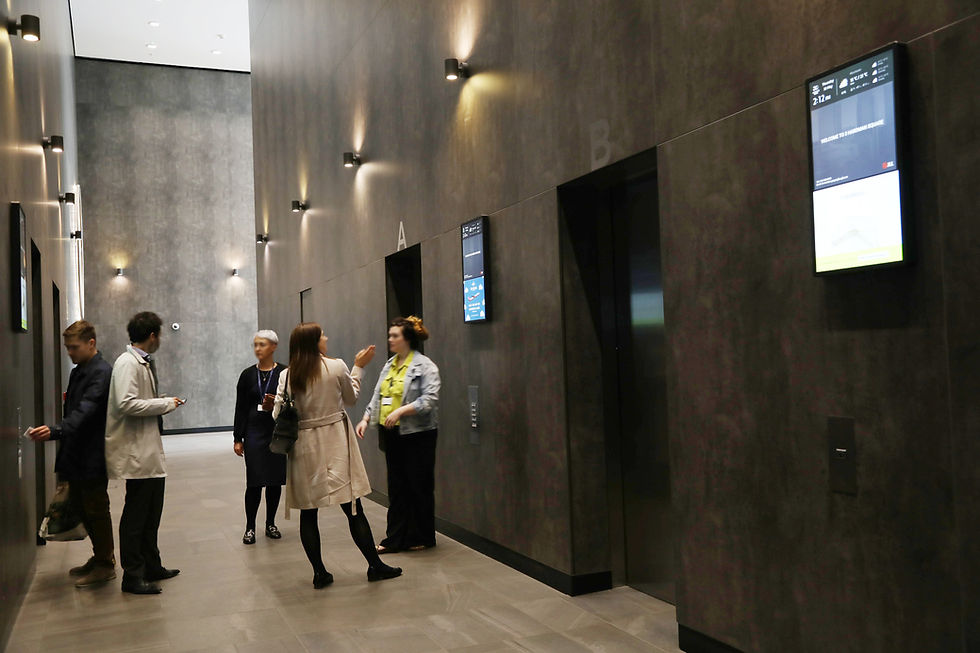
A cloud-based digital noticeboard - such as those deployed by 30Seconds Tech - allows property managers to publish notices instantly from any device, at any time. Content can be scheduled in advance, updated in real time, and archived automatically. A fire safety update that once required a site visit and a printer can now go live across every screen in a building within seconds.
The environmental benefits are intrinsic to the technology. Digital displays have an average lifespan of approximately 5–10 years, meaning a single installation replaces thousands of individual print runs over its lifetime. While printed signage can be produced using sustainable materials, frequent campaign changes often lead to increased paper waste and replacement costs - in contrast, digital signage replaces printed formats with reusable digital content.
For property managers with ESG commitments, this is increasingly significant. 30Seconds Tech has gone further still, partnering with Ecologi to carbon-offset the emissions produced by its business operations - combining the inherent paper-reduction benefits of the technology with a proactive approach to net zero.

The Resident Experience Matters Too
There is a third dimension that is easy to overlook: the resident experience itself.
A well-designed digital noticeboard does more than display information - it signals that a development is professionally managed and that residents' time is valued. It creates a 24/7 communication channel that works for residents arriving home at 11pm just as well as those passing through at 9am.
QR codes on noticeboards can connect residents to feedback forms, surveys, and tenant portals - enabling the kind of two-way engagement that digital tools are now central to delivering in modern resident engagement strategies. Paper notices offer none of this.
The Time for Change Is Now
Between mounting environmental pressure, the demands of the Building Safety Act, and the rising expectations of modern residents, it is increasingly difficult to justify the status quo.
Residential digital signage is not a luxury upgrade - it is a practical, sustainable, and operationally superior solution for any building that takes communication seriously.
To find out how 30Seconds Tech can help your development make the switch, visit www.30seconds.tech or call 0161 533 0747.
30Seconds Tech is the UK's No.1 supplier of digital noticeboard solutions for residential and commercial properties, operating across London, Manchester, Birmingham, Leeds, Edinburgh and beyond.


Comments