
The Two-Staircase Deadline: How Are You Communicating Change?
Updated: May 19
From 30 September 2026, all new residential buildings of 18 metres and above in England must incorporate two separate staircases. This piece sets out what the change demands of resident communication, and how property managers can build practices that are genuinely effective - not just technically compliant.
What the Rule Actually Requires
On 29 March 2024, the government published amendments to Approved Document B confirming that all new residential buildings of 18 metres or above will require two fully separate staircases from 30 September 2026. The threshold mirrors the definition of a higher-risk building under the Building Safety Act 2022, creating coherence across the legislative framework.
The transitional arrangements allow buildings that received approval before the deadline to proceed under the previous guidance, provided construction is sufficiently progressed - foundations poured or piling commenced - before 30 March 2028. Beyond that, two staircases are required without exception.
The rationale is straightforward: a second staircase provides an alternative evacuation route when one is compromised by smoke or fire, and improves firefighting access. But structural changes of this significance create communicative obligations that are equally important and far less discussed.

What Changes When a Building Has Two Staircases
The physical presence of a second staircase means very little if residents don't understand how it functions in practice. Evacuation strategies are site-specific. The designation of staircases for resident evacuation versus firefighting access, whether a building operates stay put or simultaneous evacuation, and how that shifts under different fire scenarios - none of this is self-evident to a resident arriving for the first time.
The timing compounds the challenge. From 6 April 2026 - weeks before the staircase deadline - the Fire Safety (Residential Evacuation Plans) (England) Regulations 2025 introduce mandatory Residential Personal Emergency Evacuation Plans for higher-risk buildings. Responsible Persons must now proactively identify residents who may struggle to evacuate without assistance and develop personalised evacuation statements with them. In a two-staircase building, those statements need to specify which route is safest for that individual and how the answer changes depending on where a fire is located.
Research into evacuation behaviour consistently shows that people in emergencies default to familiar routes. They use the staircase they know. If residents are uncertain about a second staircase, its presence offers diminished protection.
Why Conventional Channels Fall Short
Property managers typically rely on welcome letters, email bulletins, portal notifications, paper notices, and community meetings. For safety-critical information that needs to be retained across an entire building population, each has real limitations.
Email and portal notifications require residents to have registered, have access, and actively open the message. Adoption rates for resident portals remain low in many buildings. Paper notices become background noise. Community meetings reach the already-engaged. The residents who most need safety information - those who are isolated, new to the country, elderly, or digitally excluded - are typically the least likely to be reached by any of these channels.
For safety-critical information requiring genuine retention, the most reliable approach is communication that is ambient and consistent, requiring no action from the resident to encounter it. Information that requires effort to find will always reach fewer people than information that is simply present where people already are.
What Good Communication of Structural Change Looks Like
When a building's evacuation strategy changes, responsible persons should plan for five distinct requirements:
Plain language explanation of what has changed and why, written for a general audience.
Specific guidance on evacuation routes for this building - which staircase, under what circumstances.
Information about the PEEP process delivered in a way that reaches residents who would never initiate contact themselves.
Sustained repetition over weeks and months, so information moves from awareness into recalled behaviour.
A documented record of when communication took place and what was communicated.
That last point matters increasingly. Building Assessment Certificates are being called in by the Building Safety Regulator at pace, with a 28-day submission window. Regulators and Fire Brigade inspectors want evidence that communication was ongoing and accessible - a timestamped digital archive demonstrates continuity of effort in a way that a folder of sent emails cannot.
Reaching Everyone, Including the Most Vulnerable
A high-rise residential building in any UK city contains residents who speak dozens of different first languages, older residents for whom digital communication is a barrier, and people with visual, hearing, cognitive, or mobility impairments. The new RPEEP regulations place a proactive identification duty on responsible persons - meaning communication about the PEEP process itself needs to reach people who may never open a portal notification.
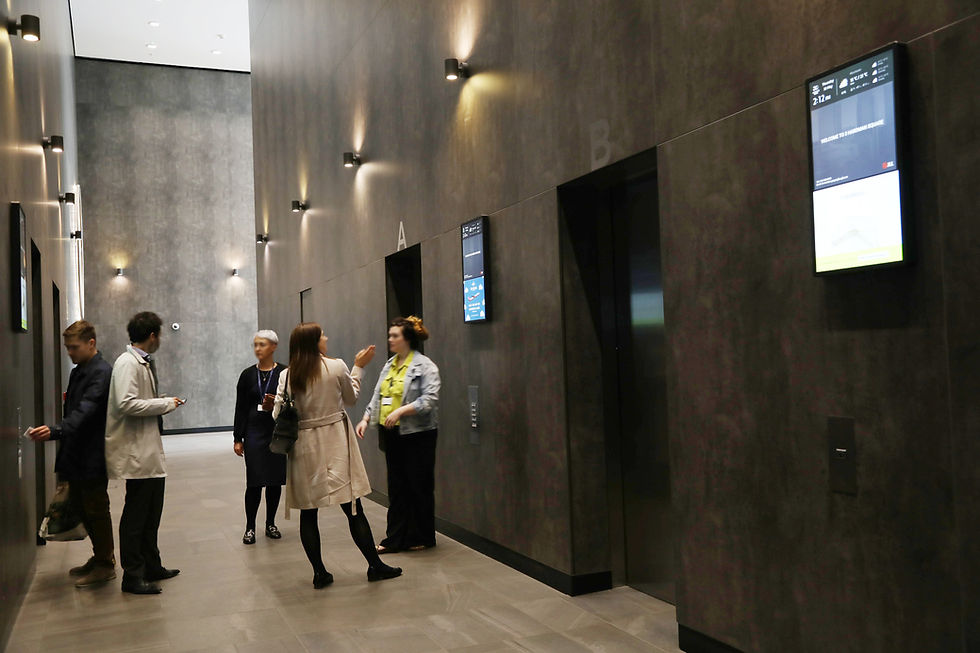
Visual communication in shared physical spaces, placed where all residents pass through as part of daily routine, removes the barriers of digital access and language confidence. It works passively, which means it works for the residents least likely to be reached by any other means. The communal spaces of a building are a communication asset. What occupies that space - and how deliberately it is designed - matters more than is typically recognised.
What to Do Before the Deadline
Six months out, these are the questions worth asking now:
Does your Resident Engagement Strategy reflect what you actually do, or what you intended to do when it was written?
Which of your buildings will be affected by the two-staircase rule, and which have evacuation strategies that need to be communicated more effectively ahead of the April RPEEP duties?
If you received a Building Assessment Certificate request tomorrow, what evidence of ongoing resident communication could you produce?
Are your communal spaces doing deliberate communication work, or are they leaving that space blank?
The two-staircase rule will make buildings structurally safer. How much of that safety is realised by the people living inside them depends on whether residents actually understand their building - and that is a communication problem, with a communication solution.
30Seconds Tech provides digital communication infrastructure for residential buildings across the UK, supporting property managers with their Resident Engagement Strategy obligations under the Building Safety Act 2022.


Comments