
ESG in Property Management: Where Digital Communication Actually Helps
Moving ESG from intention to execution
Environmental, Social and Governance commitments have become a permanent part of property management.
By 2026, ESG is no longer a badge or a reporting exercise - it is a set of expectations from residents, regulators, investors and boards.
Yet for many property teams, there remains a persistent gap between ambition and action.
Policies exist. Targets are published. Statements are signed off.
But day-to-day operations often remain unchanged.
This gap is most visible in communication: how buildings inform residents, respond to issues, document decisions and demonstrate compliance.
While ESG discussions often focus on energy performance or capital upgrades, the operational layer of communication is where many of the most immediate, measurable gains can be made.
Digital communication systems - when designed for residential environments - are increasingly proving to be one of the most practical tools available to property managers seeking to translate ESG commitments into real outcomes.
The ESG problem in property is rarely technological
It is tempting to frame ESG progress as a technology challenge.
In reality, most property organisations already have access to the tools they need.
The challenge is integration, consistency and visibility.
Common issues include:
fragmented communication channels
reliance on paper notices and manual processes
limited audit trails for resident engagement
inconsistent messaging across portfolios
high operational overhead for routine updates
These issues don’t just slow teams down - they directly undermine ESG performance.
Environmental goals are weakened by waste and unnecessary travel.
Social commitments are undermined by poor resident visibility and delayed information.
Governance suffers when records are incomplete or difficult to retrieve.
Digital communication platforms address these issues not by replacing people or processes, but by making them easier to execute consistently.
Environmental impact: small changes, measurable results
ESG discussions often focus on large-scale environmental interventions: heating systems, insulation, retrofitting. While these are essential, they are also long-term and capital-intensive.
Digital communication delivers immediate environmental benefits, often overlooked because they are operational rather than structural.
Reducing paper waste
Many residential buildings still rely on printed notices, letters, and posters to communicate:
safety updates
maintenance schedules
service disruptions
community announcements
Across a portfolio, this represents a significant and ongoing consumption of paper, ink and physical distribution.
Replacing these processes with digital noticeboards and cloud-based notice management significantly reduces paper usage.
More importantly, it eliminates the duplication and re-printing that often occurs when information changes - which it frequently does.
Cutting unnecessary site visits
A less visible environmental cost in property management is travel.
Site visits for routine communication - updating noticeboards, posting letters, responding to repeated resident queries - accumulate quickly.
Centralised digital platforms allow property managers to:
publish notices remotely
update information instantly
schedule messages in advance
confirm visibility without attending site
Fewer visits mean fewer vehicle journeys, lower emissions, and reduced time spent on non-value-adding tasks.
This is particularly impactful across multi-site portfolios.
Supporting carbon accountability
As ESG reporting becomes more rigorous, property managers are increasingly expected to evidence how operational emissions are being reduced - not just that they intend to reduce them.
Digital communication platforms contribute to this evidence base by enabling:
quantifiable reductions in paper use
demonstrable reductions in travel
consistent, repeatable communication practices
These operational efficiencies are modest individually, but material at scale.
Social impact: communication is the foundation of trust
The social pillar of ESG is often the hardest to define and the easiest to overlook.
Yet in residential property, social impact is inseparable from communication.
Residents judge management not by policy documents, but by:
how quickly they are informed
how clearly issues are explained
how visible safety information is
whether feedback feels acknowledged
Visibility matters
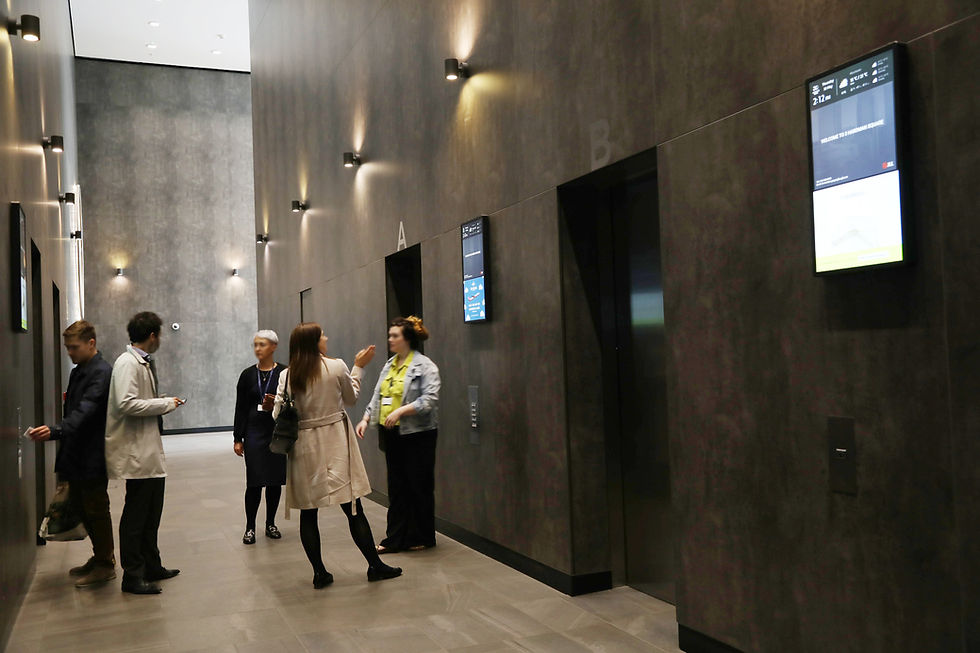
Digital noticeboards in shared spaces ensure that critical information is:
visible to residents and visitors
not dependent on email open rates
accessible without logins or apps
This is particularly important for safety messaging, lift outages, emergency updates and maintenance notices - areas where delays or missed messages can quickly escalate into complaints or risk.
Visibility supports inclusion.
It ensures that residents who may not engage with digital portals or emails are still informed.

Enabling resident involvement
Modern resident engagement is not one-way. Expectations around consultation and feedback - particularly on safety matters - are increasing.
Digital noticeboards with QR code functionality enable:
surveys and polls
feedback forms
access to detailed information via resident portals
This creates a documented feedback loop that supports both resident involvement and governance requirements.
Importantly, it reduces friction: engagement becomes easier when it happens at the point of information.
Reducing anxiety through clarity
One of the most underestimated social impacts of poor communication is anxiety.
Unclear timelines, inconsistent messaging, or outdated notices create uncertainty - particularly in residential environments.
Clear, real-time communication reduces:
repeated enquiries
frustration
misinformation spreading informally
This has a tangible impact on resident satisfaction and trust, even when the underlying issue cannot be resolved immediately.
Governance: ESG lives or dies on record-keeping
Governance is often where ESG commitments fail under scrutiny.
Good intentions are undermined by poor documentation, inconsistent processes, or an inability to evidence decisions.
Digital communication platforms directly support governance by creating automatic records of:
what information was shared
when it was published
how long it was displayed
what feedback was received
This matters for several reasons.
Compliance and audit readiness
Regulatory frameworks increasingly require proof of communication, not just assertions that it happened. Digital archives provide:
time-stamped records
centralised access
consistent formats
This reduces risk during audits, investigations or disputes.
Accountability across portfolios
For managing agents overseeing multiple buildings, governance challenges multiply. Different sites, different teams, different processes.
Centralised platforms create standardisation without removing flexibility.
Governance becomes systemic rather than dependent on individual practices at each site.
Reducing reliance on memory and manual processes
Manual record-keeping is fragile. Emails are deleted. Paper notices are removed. Staff change.
Digital records persist, providing continuity and institutional memory - a core governance requirement.
ESG in property management without operational change is performative
By 2026, ESG claims without operational backing are increasingly questioned.
Stakeholders are asking not just what commitments exist, but how they are delivered day to day.
Digital communication systems sit at the operational heart of property management. They influence:
how quickly information moves
how consistently it is delivered
how reliably it is recorded
This makes them one of the few ESG tools that impact environmental, social, and governance outcomes simultaneously.
They do not solve every ESG challenge. But they remove friction from some of the most common failure points.
Why digital communication is a low-risk ESG intervention
Unlike major capital works, digital communication platforms:
require limited upfront disruption
scale easily across portfolios
deliver immediate operational benefits
support multiple ESG objectives at once
They are not speculative investments. Their value is felt in daily operations: fewer complaints, clearer records, faster updates, and reduced waste.
For property managers under pressure to demonstrate ESG progress without increasing complexity, this matters.
Looking ahead: ESG will become operational by default
As ESG matures, the divide between “strategy” and “operations” will continue to shrink.
Reporting will increasingly reflect what actually happens on the ground.
In that environment, tools that improve visibility, reduce waste, support engagement and create defensible records will move from optional to expected.
Digital communication in buildings is no longer just about modernisation. It is about resilience, accountability and trust.
And in ESG terms, those are outcomes that matter.


Comments