
PropTech's Blind Spot: Why Digital Tools Fail at Resident Attention
Updated: May 19
Digital transformation has swept through real estate.
Mobile apps, resident portals, automated emails and chat bots are now considered table stakes for property managers.
Surveys show that younger renters in particular demand digital access: more than 81 % of Gen Z renters and 77 % of millennials value access to an online portal or mobile app, compared with 52 % of baby boomers.
Operators have responded by adopting prop‑tech platforms for lease applications, payments and maintenance requests.
Yet beneath the industry’s self‑congratulation lies proptech's blind spot.
Managers often assume that providing a digital channel equals effective communication.
This article argues that many of today’s prop‑tech tools fail at the critical moment when residents need to notice, absorb and act on information.
Important safety notices disappear among a flood of emails; push notifications arrive at inconvenient times; resident apps sit unused on the third screen of a smartphone.
It explores why digital communication misses the mark and how digital noticeboards placed in lift lobbies and entrance foyers can bridge the attention gap.
A Snapshot of the Problem
Statistics from 2024 and mid‑2025 illustrate the mismatch between digital adoption and engagement.
A Capterra survey of 4 800 tenants in twelve countries found that only 52 % have digital tools in their rental property.
In the UK the figure is lower: just 10 % of tenants have a dedicated communication platform and 19 % use online payment portals.
Those who do have digital tools are generally happy - 83 % report satisfaction - but 42 % cite technical issues.
Remarkably, only 5 % of tenants prefer to use online portals to communicate with property managers, with most favouring email or phone.
Meanwhile, 59 % of renters say they prefer text messages over email, and almost as many would rather pick up the phone.
These preferences matter because email and push notification engagement is poor: real‑estate campaigns achieve average email open rates around 35 % and click‑through rates just above 2 %; push notifications draw open rates ranging between 4 % and 20 % and a reaction rate of about 7.8 %.
In other words, the majority of residents may never even see a digital message.
Contrast this with findings from out‑of‑home media.
Research compiled by AIScreen notes that digital signage captures 400 % more views than static signage and that longer dwell times on in‑store digital displays boost recall by up to 30 % and conversion by up to 20 %.
Adding ten seconds of dwell time can increase purchases by 23 %, and 60 % of people recall digital signage content within three seconds.
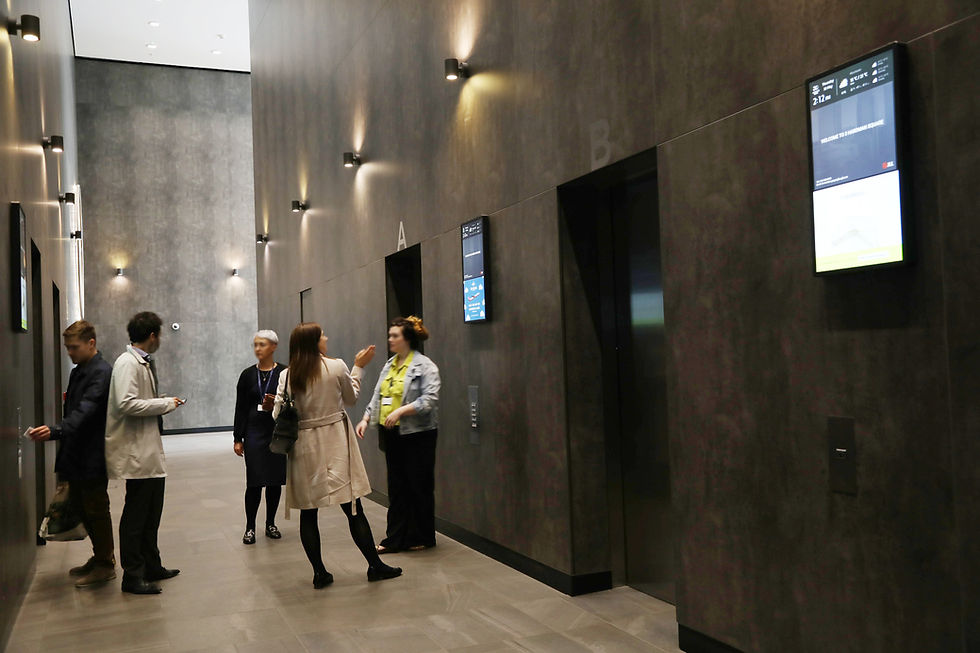
A 30Seconds Group analysis reports that waiting for an elevator typically produces a 30‑second dwell time, and because people use elevators multiple times per day, lift‑lobby screens provide repeated exposure at predictable moments.
These numbers reveal an important insight: digital screens in the built environment command attention more effectively than emails or app notifications.
Why Digital Channels Fall Short - Proptech's blind spot
If residents expect digital convenience, why are email blasts and mobile portals so ineffective?
There are several interlinked reasons:
Asynchronous delivery versus real‑time needs. Emails and portal posts are consumed on the recipient’s schedule, if at all.
Urgent notices - fire‑alarm tests, water shutoffs, maintenance disruptions - require immediate awareness.
Push notifications can be timely but are easily ignored; their open rates range from 4 % to 20 %.
Portals create additional friction because residents must remember to log in, navigate to the right section, and read the update.
Only 5 % of tenants prefer to communicate via portals, so using portals for critical alerts is like mailing a letter and hoping the recipient checks their postbox daily.
Digital overload and selective attention. The modern resident is bombarded by information.
In 2024 people encountered between 6 000 and 10 000 advertising messages daily, and average attention spans contracted to about eight seconds.
Our brains respond by filtering aggressively - deleting marketing emails, swiping away notifications and ignoring banners.
When everything arrives through the same channel, nothing feels urgent. Buildium’s renter survey emphasises that important messages often get lost in the digital “tidal wave”.
The result is that many property‑management messages are simply never noticed.
Fragmented channels and technical issues. Many property managers rely on a patchwork of email blasts, printed notices, portals and messaging apps.
When platforms malfunction or messages duplicate, residents lose trust.
This fragmentation also means managers must post the same notice in multiple places, increasing the risk of error and fatigue.
Behavioural inertia. Even when high‑quality resident apps exist, adoption requires motivation.
People are creatures of habit; they default to the channels that require the least effort.
Without repeated reinforcement, a portal becomes another forgotten icon on the phone.
In short, the problem is not that apps and portals lack features; it is that they sit outside the flow of everyday life.
Messages delivered there arrive out of context, at times when residents are not primed to pay attention.
Attention in Physical Spaces
The antidote to digital overload is contextual presence.
Residents waiting for an elevator or passing through a lobby are in a unique mental state: they are briefly stationary yet not fully engaged in another task.
This dwell time provides a fertile window for messaging.
Because residents use elevators multiple times a day, they encounter these screens repeatedly, ensuring that important information is reinforced through habitual exposure.
Digital signage also benefits from the recency effect.
In cognitive psychology, the last piece of information encountered before a decision or action tends to stick in memory.
A notice seen on a lobby screen just before entering a flat is more likely to influence behaviour than an email read hours earlier.
In short, physical context + dwell time = attention.
Closing the Attention Gap with Digital Noticeboards
Digital noticeboards placed in lift lobbies, foyers and other high‑traffic areas offer a solution to the prop‑tech blind spot. They address both the delivery and the context of communication.

Motion and sequencing. Static posters compete poorly with a digital screen that moves. Motion is not just eye‑catching; it structures information, guiding the viewer from a hook through to the benefit and call‑to‑action.
Sequencing multiple frames - such as “Upcoming maintenance,” followed by a QR code to acknowledge, followed by a special offer from a local coffee shop - makes the most of the 30‑second window without overwhelming the viewer.
Integration with the digital ecosystem. The power of physical screens is amplified when they connect with apps and portals.
30Seconds Tech’s system integrates with existing property‑management workflows, offering QR codes on screen for residents to acknowledge messages or access detailed information.
This means a notice on the screen can prompt a resident to open the app for more details, or a digital poll can be completed within seconds by scanning a code.
Managers can track who has viewed and acknowledged notices, creating an auditable trail without infringing on privacy.
Beyond Communication: Compliance, Efficiency and ESG
The benefits of on‑site digital screens extend beyond capturing attention.
Regulatory compliance and safety. Following the UK’s Building Safety Act, building owners and managers must provide clear resident engagement strategies.
30Seconds Tech platforms automatically archive all notifications and acknowledgements, helping managers demonstrate compliance.
Screens ensure that safety notices - like fire‑alarm tests or evacuation plans - are publicly visible even if residents ignore emails.
QR‑code acknowledgements create a verifiable record of engagement, reducing legal risk.
Operational efficiency. A cloud‑managed network of screens allows managers to schedule messages centrally and update multiple buildings instantly.
Instead of printing flyers or sending repetitive emails, a single update can be deployed to every lobby.
Integration with tenant portals reduces duplication and ensures consistency.
Staff time is freed to focus on higher‑value activities rather than chasing residents to acknowledge notices.
Community building and engagement. Digital screens can display more than maintenance alerts.
They can promote community events, highlight local businesses or share sustainability tips.
When residents feel informed and included, satisfaction rises; studies show that renters satisfied with communication are 25 % less likely to plan a move and nearly four times more likely to recommend their property manager.
Sustainability and ESG alignment. Digital noticeboards reduce paper waste and unnecessary travel.
Screens run on electricity that can be sourced from renewables, and remote updates mean fewer site visits.
For property owners with environmental, social and governance goals, modernising communication infrastructure contributes to ESG performance.
Future Strategies: Building a Resident‑Centric Communication Ecosystem
As prop‑tech continues to evolve, the communication challenge will persist unless operators adopt strategies tailored to human behaviour. The following principles can guide a more resident‑centric approach:
Treat communication as infrastructure. Information flow is as critical as water or electricity. Invest in dedicated channels - digital noticeboards, integrated platforms and clear processes - rather than relying on a patchwork of emails and posters.
Create synergy between physical and digital channels. Do not abandon apps or portals; instead, use lobby screens to drive digital engagement. Display QR codes that link to the resident app, run quick polls to gather feedback and promote online resources on the screen itself. Reinforcement across channels increases the likelihood that a message is seen, understood and acted upon.
Design for dwell time and context. Map the attention hotspots in your building - lift lobbies, mail rooms, gyms - and tailor messages to the time of day and audience. Morning content might include maintenance alerts and traffic updates; lunchtime messages could promote local offers; evening slots might highlight amenities or community events. Keep messages short, legible and motion‑driven to maximise the 30‑second window.
Ensure accessibility and inclusivity. Use clear fonts, high contrast and multiple languages where appropriate.
Focus on trust and utility. Residents engage when they trust that the content is useful. Prioritise safety notices, maintenance updates and community news; include advertising only when it complements the resident experience. A screen that consistently delivers valuable information will become a trusted fixture rather than an intrusive billboard.
Conclusion
Prop‑tech has delivered remarkable conveniences, yet communication remains the weakest link in property management.
Emails and push notifications are ignored by the majority of residents; portals see low adoption and technical issues erode trust.
Meanwhile, physical screens in lift lobbies and foyers command attention for up to 30 seconds, delivering recall and conversion metrics that digital channels cannot match.
The blind spot is not technology - it is the failure to meet residents where their attention naturally resides.
By embedding communication into the path of daily routines, digital noticeboards close the attention gap.
They do not replace apps and emails; they make them work better by ensuring that the initial message is seen.
When combined with contextual content, motion, programmatic targeting and integration with digital platforms, on‑site screens become a bridge between the physical and digital worlds.
As property management looks ahead to 2026 and beyond, the critical question is not whether to deploy digital tools but how to ensure they are noticed and trusted.
The answer lies in embracing presence, habit and routine - and recognising that sometimes the most effective technology is the one that stands right in front of us.
Need help bridging your communication blind spot?
30Seconds Tech provides cloud‑managed digital noticeboards and communication platforms designed specifically for residential and commercial properties.
If you’re ready to turn your lift lobbies and foyers into powerful communication hubs, get in touch.
Let’s make sure your next message doesn’t get lost in the noise.


Comments