
What the Rise of the Vertical City Means for Your Media Plan in 2026
UK cities are changing shape. For most of the last century, urban growth meant spreading outward. More roads, more suburbs, more houses with front doors that opened straight onto the street. That pattern is now reversing, and it is changing something fundamental about how people move through their days, how they encounter advertising, and where the most valuable audience moments in a 2026 media plan actually sit.

The Vertical City Is Already Here
Walk through any major UK city centre today and the evidence is hard to miss. Tower cranes above residential developments. New apartment blocks opening on sites that were car parks five years ago. Entire neighbourhoods being built upward rather than outward.
According to Barbour ABI's High-Rise Construction Market Report, 65% of all new UK high-rise buildings in 2025 are residential, up from 60% in 2021, with that share forecast to reach almost three-quarters by 2028. London has 322 tall buildings due for completion between 2026 and 2030. Manchester has 49 high-rise developments in the pipeline, Birmingham 42, with Leeds, Salford, and Glasgow all following the same trajectory. This is not a London story. It is a national shift in how UK cities are being built, and it has been quietly underway for years.
A Different Kind of Daily Routine
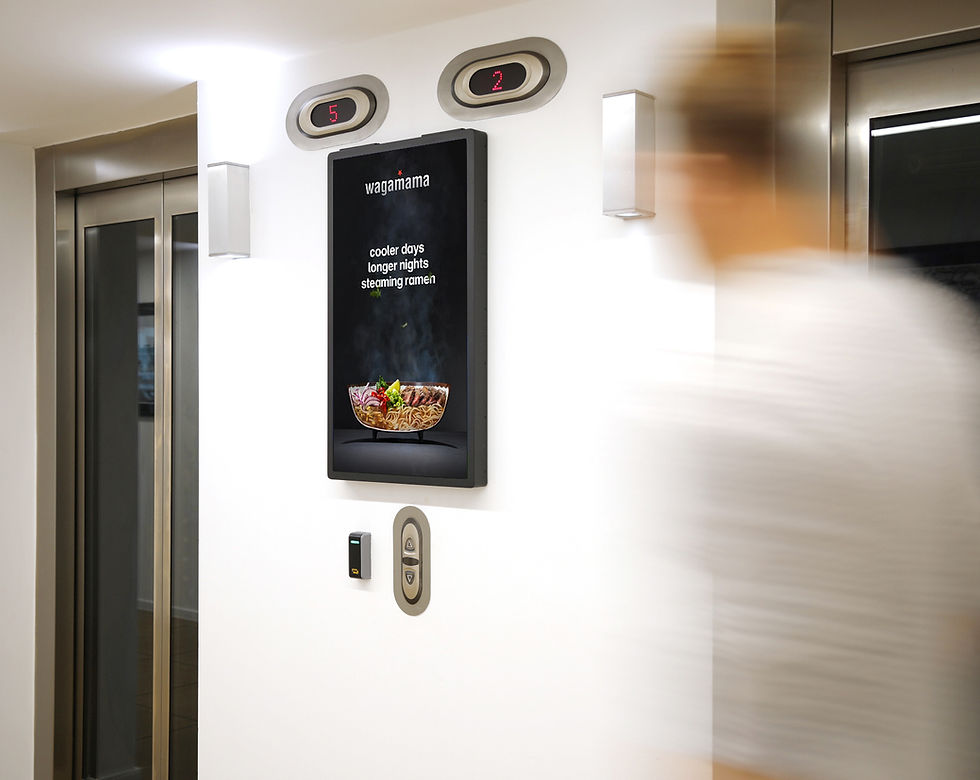
The vertical city does not just change where people live. It changes the texture of every single day. When you live in a house, your front door opens onto the street and you are immediately in the city. When you live in an apartment building, every journey begins and ends in a shared internal space: the entrance foyer, the lift lobby, the corridor between private life and everything else. You pass through it on the way out in the morning, on the way back in the evening, when you collect a delivery, when you head to the gym. The same space, the same screen, repeated multiple times a day alongside every other resident in the building on exactly the same daily schedule.
Behavioural economics has long identified transition moments as high-attention windows. The point of leaving home and the point of returning to it are two of the most consistent, predictable touchpoints in a person's entire day, and the vertical city has concentrated those moments inside a single physical space, at scale, across hundreds of thousands of urban residents.
What This Means for Audience Attention
Most media formats reach people in the middle of doing something else. Scrolling through a feed, commuting on a train, walking between appointments. The audience is always partially elsewhere, and the advertising has to fight for the fraction of attention that is available.
The lift lobby audience is different. They are waiting, stationary, in a low-distraction environment where the screen in front of them is genuinely part of the space rather than an interruption to it. Property management content on the same screen, building notices, local information, gives residents a real reason to look, and the advertising sits directly within that moment of active engagement rather than competing against it.
58% of UK consumers trust out of home advertising, and that figure rises year on year. Inside a residential building, the familiar context of the space amplifies that trust further still. The audience is not on guard against what they are seeing in the way they are against an ad served into a social feed or appended to a YouTube video.
The Dwell Time That Changes the Conversation around Media Planning in 2026
The average dwell time in a 30Seconds Media lobby environment is 30 seconds per visit. To understand why that matters, it helps to put it alongside the rest of the out of home landscape. Roadside billboards typically deliver 2 to 3 seconds of genuine audience attention. Digital escalator panels reach 6 to 8 seconds. Even the best-performing transit formats sit well below 10 seconds of actual viewer contact.
Thirty seconds is not a marginal improvement on those numbers. It is a fundamentally different contact window, and it changes what a campaign can realistically achieve in a single exposure. Full motion video lands properly at 30 seconds of dwell time. Brand storytelling has room to breathe. A call to action has time to register. Rather than a fleeting impression, the format becomes a genuine communication, and that distinction matters enormously when a planner is thinking about what a channel can actually do for a client's objectives.
Frequency Without Additional Spend
What makes the residential DOOH channel commercially distinctive is not just the quality of a single exposure, but the frequency of that exposure across the same audience without any additional cost per contact. Building residents use lifts multiple times every day. A commuter encounters the lobby screen at minimum twice, once leaving, once returning, and most encounter it three to six times across a typical day. That is a frequency pattern that would require significant broadcast budget to replicate through any other channel, and even then it would arrive in fragmented, distracted contexts spread across different platforms and dayparts.
Inside a residential building, that frequency is structural. It comes from the daily routine of the audience, not from additional media investment, and a campaign running in a 30Seconds Media location is, in effect, running a high-frequency channel within the building for the full duration of the flight. The compounding effect on brand recall, mental availability, and purchase intent across a campaign period mirrors what broadcast frequency achieves, but in an environment that is low-distraction, familiar, and trusted in a way that broadcast rarely is.
The Last Screen Before Home
There is a specific and underappreciated commercial value to the moment of return. A person arriving home in the evening has spent a day making decisions, encountering advertising, and processing information. They are about to enter a private space where no advertising can reach them, and the lobby screen is the final brand message they see before that door closes behind them.
Purchase decisions do not always happen at the point of exposure. They form over time, shaped by the accumulation of impressions and the recency of the last few before a decision environment is entered. For a resident arriving home in the evening, the lobby screen is the last thing they see before they reach for their phone to order dinner, search for a product they have been thinking about, or decide whether to book something they have been considering all week. That proximity to the moment of decision is what gives the channel its commercial weight, and it is why Route1's full econometric model, which connects campaign exposures directly to sales data, consistently finds measurable uplift at the point of purchase for brands running residential DOOH as part of a wider campaign.
A Network Built for the Cities That Are Being Built
30Seconds Media operates the UK's leading indoor media channel across 650+ screens, 530 sites, and 20 UK cities, delivering 4 million weekly impressions across residential and commercial buildings. The network is growing in the same cities where the high-rise pipeline is most active: Manchester, Birmingham, Leeds, London. Every new residential development that opens is a new concentration of the audience profile this channel reaches best, urban, ABC1 professionals with an average household income of £41,801 on the residential side and an average salary of £41,365 on the commercial side.
As the vertical city expands, the network expands with it. The structural growth in UK apartment living is not background context. It is the commercial case for why residential DOOH belongs in a modern media plan.
What the Vertical City Means for Your Next Plan
The out of home advertising landscape was largely designed around how cities used to work: horizontal, street-level, with audiences moving through external spaces on predictable routes. A growing share of the urban population now begins and ends every day in a shared internal space, passing the same screen at the same moments, as part of a routine that repeats without variation from one week to the next. That routine is the media opportunity, captive, repeated, and trusted, at the exact transition point between home and everywhere else.
To add 30Seconds Media to your next plan, contact hello@30secondsgroup.com or call 0161 533 0747.


Comments