
What DOOH Companies Need to Talk About More: Dwell Time
The metric that predicts whether your campaign will be remembered is the one most briefs never mention.
How long does your audience actually spend with an OOH ad? Not how long the screen is in view. How long they spend with it.
For most formats, the honest answer is under 5 seconds. That matters more than most media plans acknowledge. The research on what happens below that threshold is unambiguous, and it has significant implications for how DOOH companies should be positioning their inventory.

What DOOH Companies Need to Understand About the 5-Second Threshold
In 2015, the Financial Times ran five brand effectiveness studies measuring the impact of time-in-view on campaign performance. The findings were striking. Partnering with major advertisers including BP, AIG, Microsoft and IBM, the FT found that ads seen for 5 or more seconds produced a 79% uplift in ad recall, a 71% increase in brand familiarity, a 51% increase in brand association, and a 58% rise in purchase consideration, compared to ads seen for under 5 seconds.
The findings are detailed in full by AdMonsters and confirmed by The Drum's coverage of the FT's subsequent push for wider industry adoption.
The FT's conclusion was direct: under traditional CPM, all impressions are valued equally. An impression lasting 1 second carries more or less the same price tag as one lasting 30 seconds. Their research showed that was a fundamental mispricing of value. The result was a new trading currency, Cost Per Hour, which charged advertisers only for ads seen for 5 seconds or more during active use.
The 5-second threshold is not arbitrary. It represents the point at which memory encoding begins to take hold. Below it, the brain processes the stimulus but does not reliably store it.
The Decay Problem
Even when an ad clears the 5-second threshold, the memory it creates begins fading almost immediately. Nielsen's research on advertising memory, published in February 2017 by David Brandt and Ingrid Nieuwenhuis, found that brand recall dropped by 50% within the first 24 hours of a single exposure to a digital video ad.
The same research carried an important nuance: for half the brands studied, recall then held at that 50% level for five days before decaying further. The decay is steep and fast initially, but it does plateau. The counter to it is repetition. Frequency builds the memory trace back up each time it fades.
This is why reach-focused planning can underdeliver on brand outcomes. A wide audience reached once is a wide audience that has largely forgotten the message by the following morning. What counters decay is not a bigger ad or a louder creative. It is the same person seeing the same message, in the same environment, repeatedly.
What the Residential Environment Changes
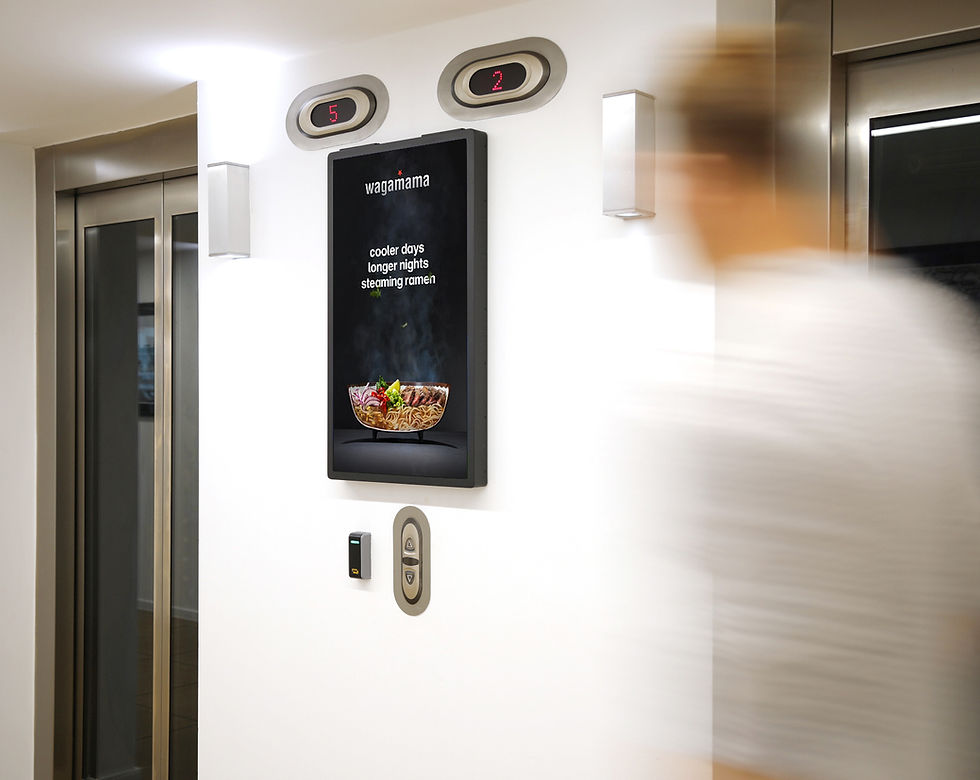
The lift lobby operates on a fundamentally different dwell time model to any outdoor format. A resident passes the screen on the way out and on the way back in. Every day. For the full duration of a campaign. Average dwell time per visit sits at 30 seconds. That is not a figure derived from traffic modelling. It is the actual time a stationary person stands in front of the screen before the lift arrives.
30 seconds clears the 5-second memory encoding threshold on every single impression. It delivers active, unaided exposure in a low-distraction environment with no competing creative. The audience is stationary. They have nothing else to look at.
Multiply that across multiple daily visits over a four-week campaign and the frequency profile is unlike anything available in outdoor advertising. A resident is not receiving one impression. They are receiving a sustained series of memory reinforcements at the same location, in the same cognitive state, at the same moments of their day. The Nielsen research on memory decay tells us exactly why that compounds into something qualitatively different.
What This Means for Creative
Dwell time changes what an ad is capable of doing. A sub-5-second exposure demands the simplest possible message: one image, one idea, stripped bare. There is no room for narrative, product benefit, or any kind of creative arc. The ceiling is set by the environment.
A 30-second exposure carries a different ceiling entirely. It can hold a narrative. It can communicate a product benefit and a reason to act. As the FT's own research showed, the longer the exposure, the greater the brand uplift across every metric. The environment determines the creative opportunity. Dwell time sets the ceiling higher.
The Pricing Gap That Still Exists
In OOH, dwell time is not yet a standardised variable in how inventory is priced. Two formats with significantly different dwell time profiles can trade at comparable CPMs, because dwell time is not a structured input into most OOH pricing models. Audience demographics, location tier, and format size all influence CPM. The time an audience actually spends with the ad largely does not.
Planners who understand that difference are buying a materially better quality of exposure for the same budget. That is a planning advantage available right now, without any change to how OOH is formally priced.
The Measurement Layer
Understanding that a format delivers superior dwell time is commercially useful. Being able to connect that dwell time to sales outcomes is what moves the conversation from qualitative to plannable.
Independent attribution through Route1 connects campaign exposures across 30Seconds Media's residential network directly to sales uplifts, web traffic, and brand recall at the household level. The measurement methodology is the same standard applied to any accountable channel in a media plan. Dwell time drives the exposure quality. Attribution confirms what that quality produces.
30Seconds Media operates the UK's leading indoor residential DOOH network. For network information visit www.30seconds.media


Comments